The Hawk and His Boy, the first book in the Tormay Trilogy, is now available on Audible.com. If you’re an audio-book lover, click on over and get a copy. The very talented Wayne Farrell did the narration, and he’ll be narrating books two and three as well. I’m extremely pleased to have another format available. I suppose the next format to tackle would be a film or TV version. If anyone has Joss Whedon‘s cell phone number, please let me know.
Category: indie authors
RT Bookfair, Aspiring Authors, the end of the World, etc.
So, the RT Bookfair just occurred in New Orleans. It’s one of the deals where booksellers and authors and readers show up to mingle and meet and buy and giveaway and all that sort of thing. The indie authors and smaller presses with nonreturnable books (ie., books sold on consignment) were put in one room and the traditional pressers were put in another. A lot of indies have been grumbling about this, particularly in light of an RT staffer who referred to them as “aspiring authors.”
Well, you know what? Who cares. It’s not the end of the world. At least you haven’t been kidnapped by Boko Haram thugs in order to be sold into slavery via a forced Muslim marriage. Heck, it could always be worse. The Spanish Inquisition could start up again, right on your lucky little doorstep.
Speaking of the end of the world, I’m starting to grow a bit weary of all the dystopian novels. I realize trends are things that people jump on (like: flying carpets, trolleys, and spiders that stroll across your kitchen floor), but the trendification of publishing is starting to become a Sight to Behold. A trend begins and then a vast wave of similar widgets surge their way across the landscape, singing in chorus and all painted the same color (see: have I seen those abs before?).
It would be fascinating if someone did a study of publishing and analyzed trends. Did trends occurs in the Ye Ancient Dayes of Yesteryear like they do now? Twilight…instant vampire trend! Hunger Games…instant dystopian trend! Some book with abs on it…instant New Adult trend! When Tolstoy published War and Peace, was there an instant Massive Russian Novel trend?
I’m thinking…no.
Okay, back to the Seal Whistle. 109 pages so far. I’ve noticed something interesting while writing this story (and, by the way, if you haven’t read my Tormay trilogy, the Seal Whistle takes place in that same land…go read The Hawk and His Boy if you don’t know what I’m talking about; it’s free). I started out with a specific plot in mind, specific characters who are from the Tormay trilogy or related in certain ways to those books. The characters have strongly asserted themselves in the process and are basically demanding page time to do what they want. Even if it really has nothing to do with the plot. I realize that authorial wisdom says one should edit and prune out such passages. However, these characters will probably beat the stuffing out of me if I do that.
Rare Interview of Master Criminal Greg Downs
I first met Greg Downs when I was serving in the French Foreign Legion in Namibia. We were taking fire from a heavy platoon of British tourists. Ladies, mostly named Hortense or Mabel, elderly and wearing those tight compression stockings that assist in varicose-vein sublimation. They had the usual assortment of mortars and 6-inch recoilless rifles and RPGs. Plus, they had a sniper the Namibians called the Suet Death Pudding who could shoot the cigar out of your mouth from three miles out. We were pinned down, outgunned, out-womaned, and in need of backup. I remember Greg well because he had the foresight to bring a cooler of pastrami and stone-ground mustard sandwiches on a nice marbled rye, and a few bottles of cold beer. He was a good man. We lost touch, however, when he went to work for the Chinese Tongs in Macau. Mostly smuggling guns and pharmaceuticals and misfortune cookies into Belgium.
Anyway, I ran into him recently at a performance of Swan Lake at Carnegie Hall. Mikhal Gorbachev was dancing lead, along with Al Gore as the Prince. It was a hard thing to watch, but that’s why I always bring along a flask of the even harder stuff. We got to talking during the intermission, while people were running out, screaming about the end of the world and hollering stuff and looking nauseated.
While I know Greg, I’ll pretend I don’t, for your educational sake.
So, while I know you, for the sake of discussion, who are you?
My name is Greg, but who I am is rather difficult. I think the answer has to do with writing, at least somewhat, or I wouldn’t be here, would I? It started in highschool, when I wrote and published some short books on Kindle, my Song of the Aura series, which is when I met Mister Christopher here.
To date, I have published three books: one, a collection of novellas and short stories, two, a novel reimagining King Arthur’s world through the eyes of the (guy you thought was the) villain, and three, a big hulking fantasy epic compiled from that series I mentioned. Nowadays I mostly just doodle, write poetry, blog a little, and go to college.
One day I’ll know who I am, too. Then I’ll tell you.
Speaking of King Arthur, what are your thoughts on modern education and its role in either encouraging or stifling creativity?
I just read Farenheit 451 by Ray Bradbury, where the kids are given more and more information in school, are schooled earlier and earlier, and learn less and less of what will actually give them meaningful lives. I think we’re on the threshold of that. Creativity is not killed by modern education, not judging by all the creative public-schoolers I’ve met, but it’s giving it its best try.
Ray Bradbury was a good man. I have fond memories of that evening he shot up a Taliban bar in Kabul. Good times. Speaking of the Taliban, what are your thoughts on the self-pubbing/indie movement?
I think it’s a great way to encourage people to write more, read more, and generally get involved. It does have a tendency to create a swamp of various amateur books, but I think 50 Shades shows us that everywhere is a swamp nowadays. So really, we have a lot to gain by people taking their writing and their careers in writing into their own hands.
I’m with you there. 50 Shades is to books as Robespierre is to democratic rule. I’ve even heard that those geniuses in Hollywood are in pre-production on a film version. Do you think Hollywood is maintaining its creative edge or losing it?
I think a lot has been lost from a thematic point of view, but a lot has been gained in a visual sense. We have a lot of really good ways to portray events and characters that we didn’t have before… but we don’t use a lot of that potential. Instead we just blow more things up. And then more. I am watching less and less contemporary film nowadays so I think I’ll stop there.
Contemporary film seems to be all about the big name actors and actresses who, frankly, seem to be mostly several noodles short of a bowl of Vietnamese pho. Lately, that’s exemplified by Gwyneth Paltrow and Chris Martin’s “conscious uncoupling” end of their marriage. The subtext in that is they are crazier than mercury-addicted loons. Speaking of marriage, do you think marriage should be arranged by the State?
No. See 1984 for details.
Ah, yes. 1984. Every year is 1984 these days. So, what is creativity and how do we access it and are we truly individual with it?
Got to admit this is my favorite question and I was waiting for it the whole time. So naturally instead of answering it directly I want to go on a tangent. Plato, in his Ion, reckons creativity as a sort of inspiration that begins in a Divine Source (the gods), and proceeds down in a chain from the gods themselves, to the poets and artists, to the performers of poetry. I find that idea a lot more interesting than calling creativity a mush mix of social/political/historical/psychological sources that kind of bubbles up from us every time we put pen to paper (or fingers to keyboard, as it now were). Think about it. What if creativity was not brainwaves, but a Divine Light we could tap into? What if our creativity, what you might call our artistic self, is like a crystal that the light shines through? When we hone our artistic craft, we chisel at, refine, and polish the crystal. We determine its shape by the life experiences and art experiences we have, and this shape, whatever it is, will reflect the Divine Light in a different way. So if this were true (I don’t know if it is, but it’s worth thinking about), then creativity is something beyond us, which we nevertheless have a good amount of individual control over. So, yes and no, as the elves say.
Very wise of you to retreat to the elves. I’ve always admired their thought processes, but not their sartorial sense. Too many tight pants. Speaking of tight pants, do you think the government is hiding information from us on things like extra-terrestrials, etc?
I could answer that question, but then I would have to kill you to protect my employers.
I trust they’re paying you well! Thanks, Greg, for taking the time to come on by and chat. If anyone wants to learn more about Greg Downs–the man, the writer, the cheese expert–stop on by his blog and spend some quality time.
The homogenization of Bookbub
Let me be clear (as Obama is fond of saying). Bookbub is the best deal in advertising for indie books. I’ve had some amazing success with them. Good explosion for the dollar. Or, as the marketing twirps are fond of saying: positive ROI. There isn’t much out there that rivals Bookbub, all due to their slice and dice email lists. Facebook ads, Google ads, blog ads…pretty much worthless. Save your nickels and buy yourself a coffee (what is with how expensive coffee is these days? Is it because they call it fancy Italian names? Whatever, Starbucks.).
However, I’m starting to notice a numbing homogenization of the blurbs in my morning Bookbub email. I’m signed up on the Fantasy and Thriller/Mystery lists. All the book summaries, complete with exclamation marks and quotations from the Library Journal (“remarkable!”, “ground-breaking!” “nausea-inducing!”), are starting to look the same. It’s almost as if the Bookbub staff create those summaries by using a Madlibs book.
“This remarkable novel stars Sabrina, nursing a broken-heart as she tries to flee a hot-abbed investigator and finds a corpse in her bathtub and uncovers a conspiracy that reaches to the very halls of power and plunges into a whacky whirlpool of chaos, geckos, and disco dancers all bent on world destruction! Heck, this story will even rip the fabric of reality! This utterly disturbing and heart-warming tale has over eight zillion five-star reviews on Amazon!”
Yeah, whatever. Gimme an old PG Wodehouse and I’m happy. Er, plus some Brie and crackers. Any maybe my tax return. Come on, IRS! If you can track everyone so amazing and awesomely, you can cut my check and put it in the mail.
A Pius Man…
No, you read that correctly. It might be your lack of Latin kicking in. Or your lack of Babylon 5. Whichsomever the case, I’d like to introduce you to Declan Finn, the man, the author (pius or pious or not), the taxpayer. So, without further ado (does anyone still drink Mountain Dew, or is my mind feebly reaching toward a confluence of soda and hair styles?), here he is. I, of course, have questions. He has answers.
Thank you, Mr. Finn, for stopping on by today. By the way, who are you?
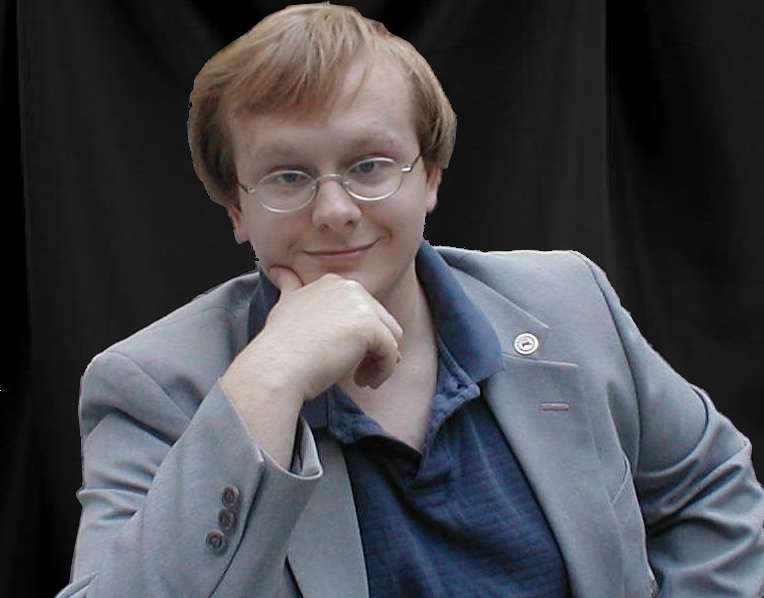 If I were truly snarky, I would answer “Who do you say that I am,” but I don’t have quite that much chutzpa. I am Declan Finn, author of A Pius Man: A Holy Thriller, and co-author of Codename: Winterborn. I’d be tempted to answer “a Madman with a box” or “Don Quixote,” but the voices in my head tell me that it’s not a good idea, people might get the wrong impression. Yes, that is a joke, though my characters do talk to me from time to time. I’m also a lifelong Catholic/Conservative/New Yorker, trained in hand-to-hand combat, with degrees in history and philosophy. Which means that I know just enough about everything to be really interesting at dinner parties.
Ah, dinner parties. I once attended a dinner party in Addis Ababa where I encountered a rather sautéed cockroach on my plate. I suppose he had a few relatives in New York, but I neglected to inquire. I also digress. Back to you. Why do you write instead of weaving baskets, growing heirloom tomatoes, or invading small countries with negligible armed forces?
I write mainly because I have to. I feel compelled to. This compulsion hits especially hard when I wake up in the middle of the night and I have to run to the nearest notebook (by my nightstand) in order to take down everything I just thought of before I forget it all. Heck, no one with an ounce of sense should go into professional writing unless there is nothing else for them. By that I mean that most writers I’ve come across all seem compelled to write professionally. We almost all lay in bed in the middle of the night and keep a notebook close at hand so we can write down ideas before we forget them. Or we start writing a simple amusing fact and suddenly fill the page with an outline for a novel. Writing is our drug. Our addiction. A neurotic, uncontrollable impulse. We would go insane if we didn’t write… Or merely more insane.
In the case of A Pius Man, I wrote it because I realized that more people probably learned “history” from novels than they ever did in grammar school. And there were plenty of novelists who were quite willing to lie about Pope Pius XII in order to sell a story. I wasn’t. So, A Pius Man.
True. I learned no history at all in grammar school, other than certain details about the modern drug trade in California. That was more experiential knowledge than academic. Speaking of experience, what is your personal philosophy of life and how does that affect what you write?
My philosophy of life? I’m trying to figure out if that means my belief system or if that means how I approach life. If it’s the former, my belief system is natural law as viewed via my Catholic faith. Politically, that translates as something conservative/libertarian, depending on how one looks at it.
If you mean how I approach life… I usually try to sneak around life, flanking it, then running at it with a hammer. Patience is a good and noble virtue, but being blunt has its virtues. I’m not entirely certain I answered the question, but it’s the best I have right now.
Being blunt certainly does have its virtues. As Churchill said, speak softly and carry a big battleship. What are your thoughts on the idea that authors (artists) have (or do not have) a moral obligation to their readers in terms of doing no harm, bettering them, ennobling their views of life, etc?
At the very least, art – or at least fiction – has to be edifying. It should build people up, not break them down. If I read a book, I want to come away feeling like something has been added to my life, not taken away from it. Watching Die Hard doesn’t add much to my life, but it will at least give me some entertainment. Reading Dan Brown makes me lose brain cells.
I’ve often wondered (well, at least twice) if there really is no Dan Brown, but that his books were simply cultivated in petri dishes. Lab-grown kidneys gone wrong. Speaking of kidneys, what are your thoughts on modern pop culture?
Modern popular culture? Well, if you go by the bestseller lists – James Rollins, Jeffery Deaver, Lee Child, etc – the popularity of smart writing is most encouraging. If you go by “reality television,” celebutards being called in on political panels, and the amount of air time dedicated to the media lynching George Zimmerman, then I think we’re all doomed.
Yes, we are all doomed. No doubt about that. My parents were fond of telling us that when we were small, despite sunny weather and blue skies. Speaking of skies…I think Blue Sky Studio was inadvertently prophetic when they wrote that charming little scene into Ice Age of the dodo birds chanting “Doom on you! Doom on you!” Not exactly Isaiah, but good enough for our times. Now, onto your books. Can you give us a run-down on your latest story?
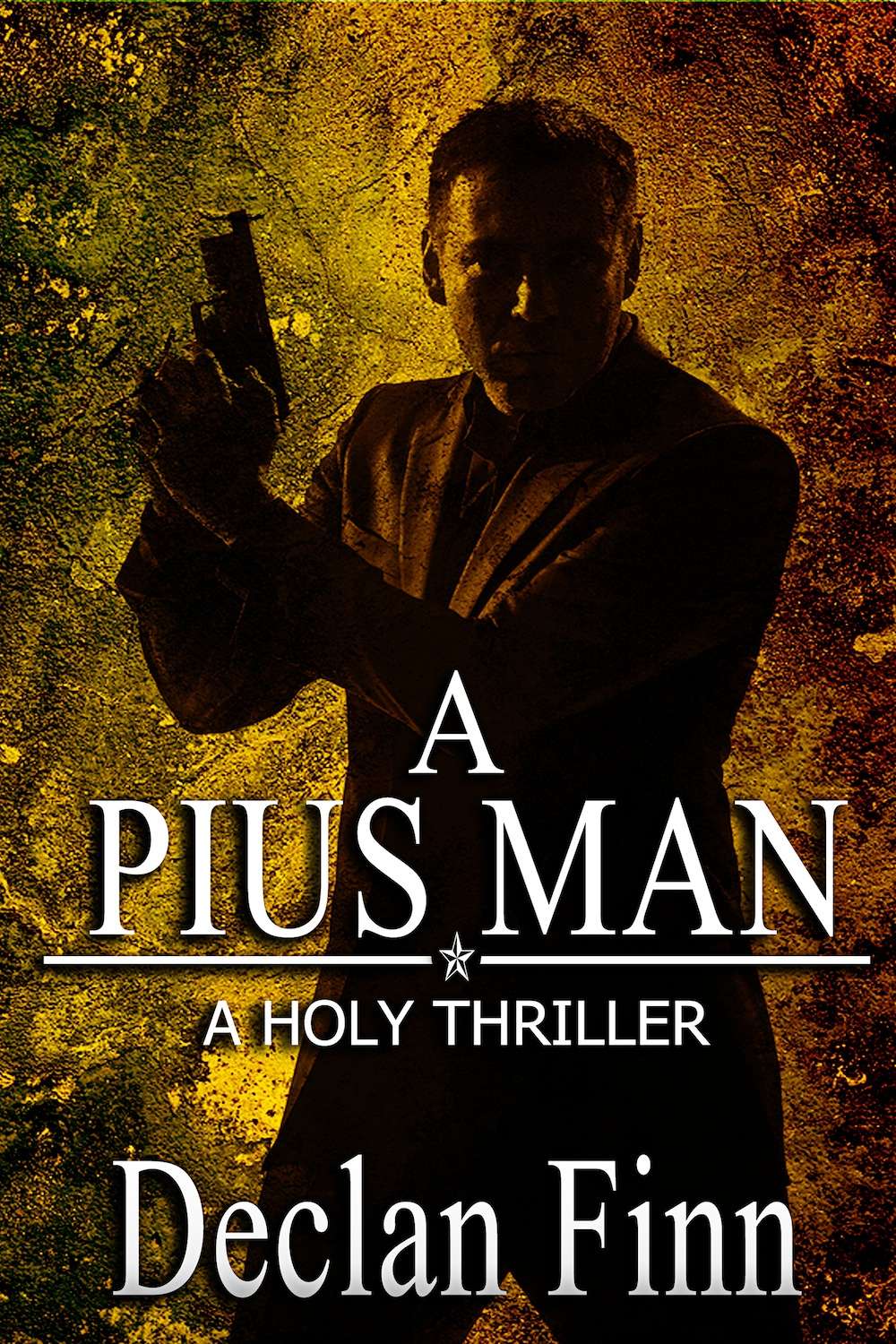 A Pius Man: A Holy Thriller starts with a visitor to the papal archives being assassinated, and his assassin being blown out of a window, landing face-first into a car windshield. The car belongs to the head of Vatican security. In short order, they discover that people going into the Vatican archives on Pope Pius XII – aka: “Hitler’s Pope” – are dying. It has a nice collection of suspects, including the Pope himself. Like all other fiction involving the Catholic church, it has decades-long conspiracies, sinister-looking priests, and even the Pope is a suspect. However, there are two big differences between A Pius Man and the others. One, all of the history in this book is real – seriously, it started out as a graduate paper. Second, I take great joy in using every single cliché about the Catholic church, and turning them upside down and inside out.
What are a few books you’ve read lately that you greatly admire and recommend?
Any of James Rollins’ Sigma novels – his most recent is The Eye of God, but I’m not certain if anyone could track it without reading the prior novels. If you want a thriller where technology and history meet, you want to read Rollins – who has been writing before anyone ever heard of Dan Brown. I recently tripped over an author named Jeff Abbott, and his Sam Capra novels are fun.
Thanks for those recommendations. Finding good books is always a bit of a chore these days. Now, as we draw this interview to a close, to its little death, let me inquire about your own (not that I’m particularly morbid, but, well…death is part of life, and vice versa). What would you like to be remembered for after you die?
What would I like to be remembered for? I would like to be remembered as that guy who started out self-publishing his books with A Pius Man: A Holy Thriller, sold millions of copies of his entire trilogy, and made every wannabe-historian thriller writer obsolete.
But, being real… Seven or eight years ago, I gave my friend and co-author, Allan, a novel – Good Omens by Prachett and Gaiman. When he put that down as “What I’m reading” on a dating site, someone saw it and said hello. They are now married, all because I gave him a book. I’ll settle for that.
Great story. Books do draw people together, either for reading or burning. Best of luck (though, I don’t believe in luck) to you with your writing, paying of taxes, and other pursuits!
—
You can visit Declan Finn at his blog and his author site. A Pius Man is available in print, for Kindle, and on Barnes & Noble. His other book, Codename: Winterborn, is also available online at Barnes & Noble and Amazon.